Governed basis
MAGS is built to work from the sources that actually matter. Directives, standards, procedures, and client-specific context. Not loose internet content or unvetted material.
Defensible Before Reporting
We help operators strengthen measurement defensibility before results are relied on for reporting, accounting, engineering, emissions, compliance, or management use.
Most systems look acceptable until assumptions, methods, traceability, and evidence are actually tested.

Oil and gas operators are right to be cautious about AI, cybersecurity, and data handling. These are not things we brush past. They are part of how we work from the start.
MAGS is not unrestricted AI access to your operational data. Security review, scope boundaries, and human review are built into the adoption process.
Your auditor does not care what the AI thinks. They care what it can cite.
MAGS is built to work from the sources that actually matter. Directives, standards, procedures, and client-specific context. Not loose internet content or unvetted material.
You start with the scope that fits your situation. One problem. One workflow. One facility. Adoption is deliberate and grows from there.
The public walkthrough on this site does not use client data. Client-specific deployment, access, and data-boundary questions are handled directly in adoption review. Security questions are expected.
Every output is meant for human review. MAGS supports your judgment. It does not replace it.
Reliable Measurement is a measurement assurance practice backed by a governed system.
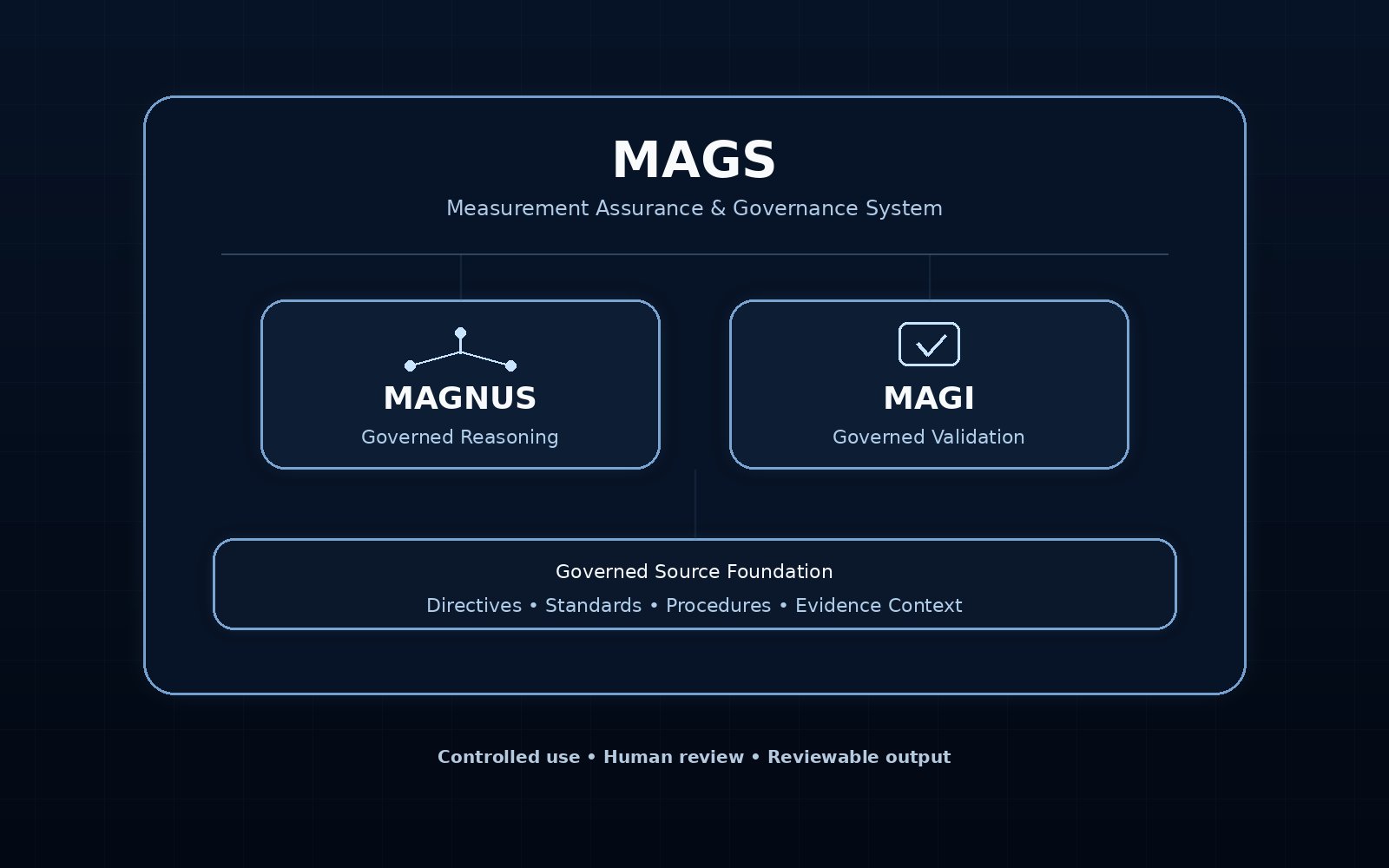
Measurement Assurance and Governance System. The governed framework that connects requirements, reasoning, validation, and evidence support.
Governed reasoning for measurement questions. Method applicability, gap diagnosis, and guidance from governing requirements to a defensible state.
Governed validation of measurement outputs. Challenging reported values, testing assumptions, and checking defensibility before you rely on the result.
Know what governs your measurement. Find what is weak. Fix what matters first. See what still remains exposed.
Pick the problem that matters most. Start there.
Know where your measurement program actually stands before the next audit or review cycle. Scored against a standard rubric. Prioritized by consequence.
Start assessmentPrepare for or respond to an EPAP notification. Control-to-requirement mapping, gap identification, remedial action prioritization, evidence readiness, and declaration support.
Discuss EPAP supportFind out whether your proving, sampling, calibration, and operational records actually support the volumes you report.
Review an evidence gapScope a specific measurement problem. Proving, sampling, allocation, emissions measurement, or another specific family. Work it to a defensible resolution.
Discuss a scoped issueMAGNUS and MAGI can support these scoped engagements or broader governed adoption where needed.
Partial adoption is useful. Partial adoption is not full program closure. But starting with the right problem in the right order is how defensible programs get built.
Your EPAP declaration is due and you are not confident your evidence would hold up under scrutiny.
Your allocation has not balanced in months and nobody can explain the variance or trace it to a root cause.
You are onboarding a new facility and need the measurement program built right the first time.
Your auditor asked for proving records or sampling documentation and the team could not produce them.
You follow every AGA and API standard but the regulator still flagged your program and you are not sure why.
Your emissions report depends on fuel gas and flare measurement that has never been independently validated.
You inherited a measurement program you did not build and need to know where the real gaps are before the next review.
Your field does one thing and your office reports another and nobody noticed until now.
A direct conversation about the measurement problem, the regulatory context, and the exposure. No intake forms. No sales process.
We identify where the defensibility gaps are, what the governing directive requires, and what it would take to close them.
Where your measurement program stands, what needs to change, and in what order. You decide what happens next.
This walkthrough shows how MAGS connects governed source material, reasoning, validation, and evidence support into a disciplined measurement assurance workflow.
It is meant to help operators understand the governed model before discussing scope, boundaries, or adoption. The walkthrough includes a governed interaction example showing how MAGS identifies what to fix, why it matters first, what risk it reduces, and what still remains exposed.
This is a public walkthrough. It does not require client data. Client-specific use is discussed separately under security and adoption review.
MAGS is not a chat tool that generates text and calls it defensible.
It is not a compliance shortcut. It is not a generic AI assistant with access to your operational data. It is not a replacement for engineering judgment, field evidence, or implementation work.
MAGS is a governed measurement assurance system. It helps you know what governs, find what is weak, fix what matters first, and see what still remains exposed.
Reliable Measurement was founded by Doug Sanders, a measurement and regulatory specialist with direct experience across upstream and midstream operations in Alberta, Saskatchewan, and British Columbia. It is grounded in field work, audit experience, and governance design.
MAGS can support work delivered directly through Reliable Measurement and can also serve as a governed support layer inside operator, midstream, and specialist consulting teams that need more consistent reasoning, validation, and evidence support.
Security, data-boundary, and adoption questions can be addressed directly in the first conversation.
The best time to strengthen your measurement program is before the next review cycle, not during it.
Typical starting points include a defensibility assessment, EPAP support, evidence review, or a scoped workflow problem. If you are not sure where to start, that is fine. The conversation will help scope it.
When you reach out, it helps to include: